
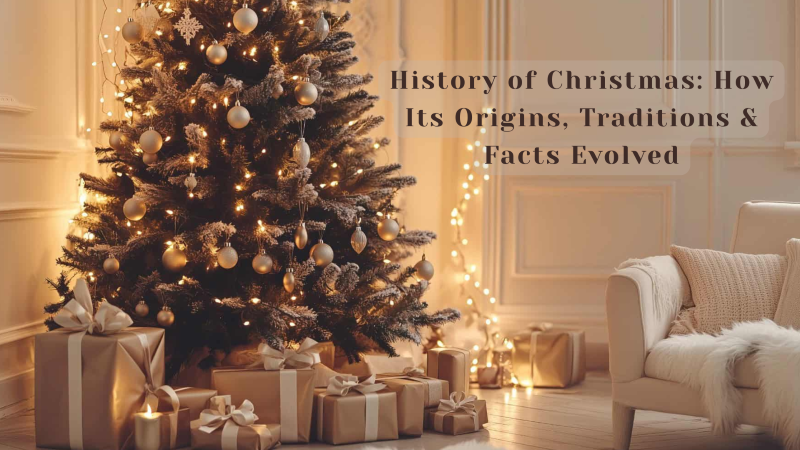
The history of Christmas: the ancient winter festivals that preceded it, why 25 December was chosen, how its symbols — the tree, the star, the nativity scene, Santa — took shape, how it is celebrated around the world and in India, and its lesser-known facts.
Christmas, celebrated on 25 December, marks the birth of Jesus Christ. Rooted in Christian faith and shaped over two millennia by Roman custom, medieval Europe, Victorian Britain and modern culture, it is today observed by around two billion people, many of whom are not Christian. This guide traces that long journey.
What Winter Festivals Came Before Christmas?
Long before the Christian era, peoples of the northern hemisphere marked the winter solstice (21–22 December), the year’s shortest day, as the moment the sun began to return:
- Saturnalia (Rome), held 17–23 December in honour of Saturn — a festival of feasting, role reversal and small gifts.
- Dies Natalis Solis Invicti (Rome), the birthday of the “Unconquered Sun”, observed on 25 December from the 3rd century.
- Yule (Germanic and Norse Europe), when the Yule log was burnt and evergreens brought indoors.
Feasting, gift-giving, evergreen decorations, candles and communal singing all belonged to these midwinter celebrations before they became part of Christmas.
Why Is Christmas Celebrated on 25 December?

The Gospels describe Jesus’s birth in Bethlehem but give no date, and early Christians did not agree on one. The earliest firm record of a Christmas celebration on 25 December comes from the Roman Chronograph of 354, which notes the observance in the year 336. (Tradition often credits Pope Julius I with fixing the date, but the historical evidence for this is uncertain.)
Historians offer two main explanations:
- The solstice theory: the date was chosen to coincide with existing Roman sun festivals, with Christ presented as the true “Light of the World”.
- The calculation hypothesis: early Christians dated the Annunciation — Christ’s conception — to 25 March, placing his birth exactly nine months later.
Many Orthodox churches, following the older Julian calendar, celebrate on 7 January.
How Did Christmas Develop in the Middle Ages?
Through the Middle Ages, Christmas grew from a church feast into a season of celebration — the Twelve Days from 25 December to Epiphany on 6 January — with Masses, nativity plays, music, feasting and decoration with holly, ivy and mistletoe.
- Nativity scenes: St Francis of Assisi created the first living nativity at Greccio, Italy, in 1223, to make the story vivid for ordinary people.
- Carols: originally circle dances with song, they became devotional over time. Many favourites are much later — “Silent Night” was first sung in Austria in 1818.
Where Do Christmas Symbols Come From?
The Christmas Tree
Evergreens symbolised enduring life through winter long before Christianity. The decorated indoor tree is recorded in 16th-century Germany, and legend credits Martin Luther with first adding candles. It reached Britain through German connections and became fashionable after an 1848 illustration in the Illustrated London News showed Queen Victoria and Prince Albert around a decorated tree.
Santa Claus
From Saint Nicholas of Myra, through the Dutch Sinterklaas, to the 1823 poem “A Visit from St. Nicholas” and Thomas Nast’s cartoons. Read the full story of who Santa Claus is.
Gifts and the Star
Gift-giving recalls the offerings of gold, frankincense and myrrh brought by the Magi, and also continues the Roman custom of solstice presents. The star atop the tree represents the Star of Bethlehem that, in Matthew’s Gospel, led the Wise Men to the child.
Holly, Mistletoe and Candles
Holly and mistletoe were sacred to pre-Christian Europe and were later given Christian meanings — holly’s thorns and red berries read as the crown of thorns. Candles and lights carry the season’s oldest theme: light in the darkest days.
More festive reading: creative Christmas decoration tips and delicious themed cake recipes for the season.
How Is Christmas Celebrated Around the World?

- Europe: Midnight Mass, nativity scenes, Advent calendars and Christmas markets, which began in medieval Germany.
- United States: lights, stockings, parades and family gatherings.
- Philippines: the world’s longest Christmas season, with carols from September and dawn Masses (Simbang Gabi).
- Ethiopia: Genna, celebrated on 7 January with white robes and ancient liturgy.
Christmas in India
Christmas is a national holiday in India, known in Hindi as Bada Din, “the big day”. Celebrations are richest in Goa, with its Portuguese heritage, Kerala, home to the ancient Saint Thomas Christian community, and the North-East. Homes hang paper stars, mango or banana leaves replace fir in some places, and families share plum cake, kuswar sweets in Goa and appam with stew in Kerala. Park Street in Kolkata is famously illuminated. Indians of every faith join in with cakes, gifts and decorations — see these themed cake recipes.
What Is the Spiritual Meaning of Christmas?
For Christians, Christmas celebrates the Incarnation — God entering the world in human form, born not in a palace but a manger. That humility is the heart of the festival, and its themes of hope, peace, generosity and goodwill to all speak far beyond any one faith. In a country of many religions, Christmas joins Diwali, Eid and Navratri as a season of light, sharing and family.
Interesting Facts About Christmas

- The first recorded Christmas celebration was in Rome in 336 CE.
- Christmas was banned by England’s Puritan Parliament in 1647, and in Boston from 1659 to 1681.
- The world’s tallest cut Christmas tree, 221 feet, was raised in Seattle in 1950.
- “Jingle Bells”, published in 1857 by James Lord Pierpont, mentions neither Christmas nor Christ; in 1965 it became the first song broadcast from space, by the Gemini 6 astronauts.
- “Xmas” is not disrespectful: the X is the Greek letter chi, the first letter of Christos, and has stood for Christ for centuries.
- The Christmas card was invented in London in 1843, the same year Dickens published A Christmas Carol.
How Is Christmas Changing Today?
Traditions keep evolving: potted or artificial trees in place of cut ones, digital gifting and video calls with distant family, online carol concerts, minimalist decoration and a renewed taste for homemade food. What endures is the older core — light in the dark, generosity and coming together.
Conclusion
From Roman Saturnalia and the Yule log to a Bethlehem stable, from St Francis’s crib at Greccio to Prince Albert’s tree and a red-suited Santa, Christmas has gathered meaning across two thousand years. Knowing that history makes the festival richer.
If you enjoy the stories behind festivals, explore our guides to Diwali and Lakshmi Puja, Navratri and Lord Krishna.
Frequently Asked Questions
-
Why is Christmas celebrated on 25 December?
No date for Jesus’s birth is given in the Gospels. The earliest record of a Christmas on 25 December is the Roman Chronograph of 354, describing a celebration in 336. Historians suggest either that the date matched existing Roman sun festivals, or that it followed from dating the Annunciation to 25 March, nine months earlier.
-
When was Christmas first celebrated?
The first recorded celebration of Christmas was in Rome in 336 CE, noted in the Chronograph of 354. Before that, early Christians marked Jesus’s birth at various times of year or not at all, and the feast only gradually became one of the most important in the Christian calendar.
-
Which older festivals influenced Christmas?
Christmas absorbed customs from Roman Saturnalia, held 17 to 23 December, from Dies Natalis Solis Invicti, the birthday of the Unconquered Sun on 25 December, and from Germanic and Norse Yule. Feasting, gift-giving, evergreen decoration, candles and communal singing all predate the Christian festival.
-
Where does the Christmas tree come from?
The decorated indoor Christmas tree is recorded in 16th-century Germany, drawing on the older use of evergreens as symbols of life in winter. It became popular in Britain after an 1848 illustration in the Illustrated London News showed Queen Victoria and Prince Albert around a decorated tree.
-
Who created the first nativity scene?
St Francis of Assisi created the first nativity scene at Greccio in Italy in 1223, using a manger, hay and live animals to help ordinary people picture the birth of Jesus. The custom spread across Europe and became one of the most enduring Christmas traditions.
-
Why do we exchange gifts at Christmas?
Christmas gift-giving recalls the gold, frankincense and myrrh offered by the Magi to the infant Jesus, and continues the Roman custom of exchanging presents at Saturnalia. The legends of Saint Nicholas’s secret gifts to the poor strengthened the tradition further.
-
How is Christmas celebrated in India?
Christmas is a national holiday in India, called Bada Din. Celebrations are richest in Goa, Kerala and the North-East, with midnight Mass, paper stars hung outside homes, plum cake, Goan kuswar sweets and Kerala’s appam and stew. Indians of many faiths join in with gifts, cakes and decorations.
-
Was Christmas ever banned?
Yes. England’s Puritan Parliament banned Christmas celebrations in 1647, considering them unbiblical and disorderly, and Puritan Boston banned them from 1659 to 1681. The festival was restored in England after 1660 and revived in the Victorian era.