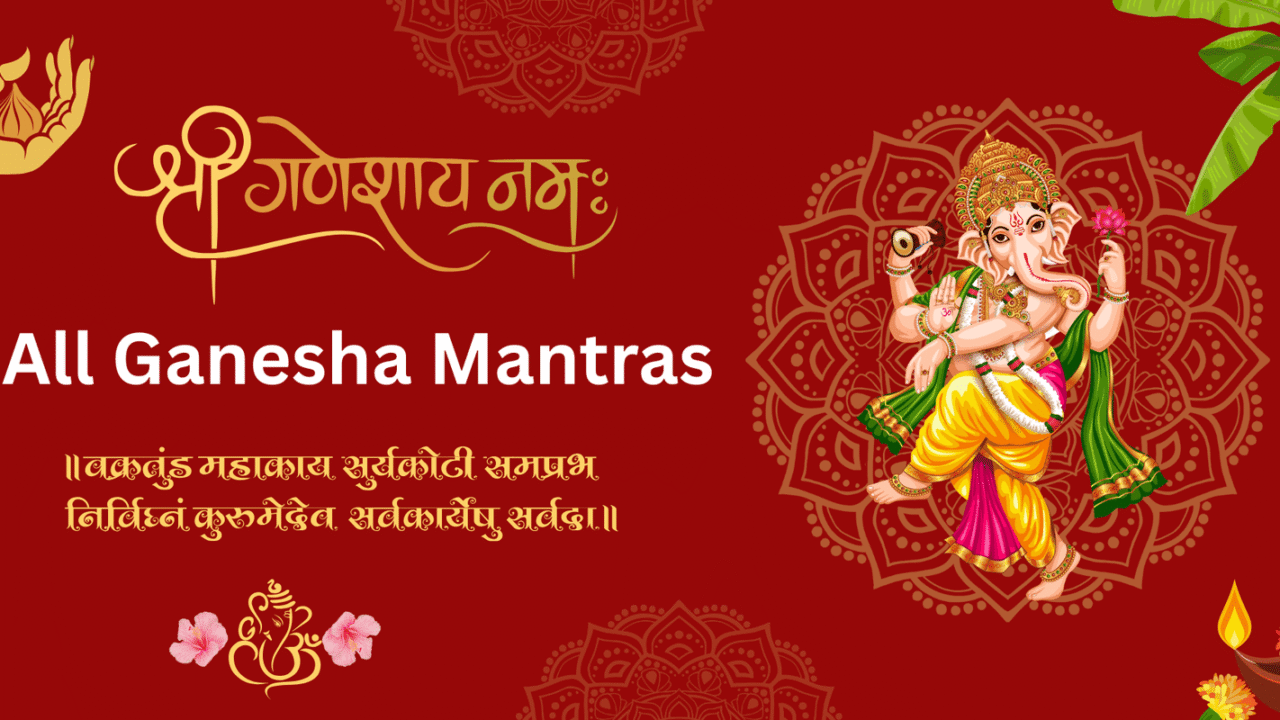
The principal Ganesha mantras in Devanagari and English, with the meaning of each, its source where known, and the traditional way to chant them.
Lord Ganesha, also known as Vighnaharta, Ganapati and Vinayaka, is one of the most beloved deities in Hinduism. Revered as the god of wisdom and new beginnings, he is worshipped first before any task, ritual or festival. Devotees chant Ganesh mantras seeking the removal of obstacles and his blessings for auspicious beginnings. Read more on the spiritual significance of Lord Ganesha.
1. Ganesh Mool Mantra
Mantra:
ॐ गं गणपतये नमः
(Om Gam Ganapataye Namah)
Meaning:
- Om — the primordial sound
- Gam — the seed syllable (beeja) of Ganesha
- Ganapataye — to Ganapati, lord of the ganas (Shiva’s attendants)
- Namah — I bow
Traditionally chanted: for the removal of obstacles and success in new beginnings. It is the most widely chanted Ganesha mantra.
2. Vakratunda Mahakaya
Shloka:
वक्रतुण्ड महाकाय सूर्यकोटि समप्रभ।
निर्विघ्नं कुरु मे देव सर्वकार्येषु सर्वदा॥
(Vakratunda Mahakaya Suryakoti Samaprabha
Nirvighnam Kuru Me Deva Sarvakaryeshu Sarvada)
Meaning:
O Lord with the curved trunk and mighty body, radiant as ten million suns, make all my undertakings free of obstacles, always.
Traditionally chanted: before beginning any work, puja, study or journey. It is the most commonly recited Ganesha shloka.
3. Ganesha Gayatri Mantra
Mantra:
ॐ एकदन्ताय विद्महे वक्रतुण्डाय धीमहि।
तन्नो दन्तिः प्रचोदयात्॥
(Om Ekadantaya Vidmahe, Vakratundaya Dhimahi,
Tanno Danti Prachodayat)
Meaning:
We know the one-tusked Lord; we meditate on the one with the curved trunk. May that tusked one inspire our minds.
Source and use: A deity-gayatri in the gayatri metre, also found within the Ganapati Atharvashirsha. Traditionally chanted for wisdom and clear thinking, and popular among students.
4. Sankatanashana Ganesha Stotram
First verse:
प्रणम्य शिरसा देवं गौरीपुत्रं विनायकम्।
भक्तावासं स्मरेन्नित्यमायुःकामार्थसिद्धये॥
(Pranamya Shirasa Devam Gauriputram Vinayakam,
Bhaktavasam Smarennityam Ayuh-Kamartha-Siddhaye)
Meaning:
Bowing my head to Lord Vinayaka, son of Gauri, who dwells in the hearts of his devotees, one should remember him daily for long life, the fulfilment of desires and prosperity.
Source: The Narada Purana. The stotram lists twelve names of Ganesha and is recited to seek relief from difficulties (sankata).
5. Shubh Labh Mantra
Mantra:
ॐ श्री गणेशाय नमः, शुभ लाभाय नमः।
(Om Shri Ganeshaya Namah, Shubh Labhaya Namah)
Meaning:
Salutations to Lord Ganesha; salutations to auspiciousness (shubh) and gain (labh). In popular tradition Shubh and Labh are regarded as Ganesha’s sons.
Traditionally chanted: by business families for prosperity, and written on account books and doorways at Diwali.
6. Rinaharta Ganesha Mantra
Mantra:
ॐ गणेश ऋणं छिन्धि वरेण्यं हुं नमः फट्॥
(Om Ganesha Rinam Chhindhi Varenyam Hum Namah Phat)
Meaning:
O excellent Ganesha, cut away my debts.
Traditionally chanted: by devotees seeking relief from debt. It contains seed syllables, and tradition recommends learning such mantras from a teacher. Chanting is an act of devotion and a support to effort — not a substitute for practical financial planning.
7. Ganesha Beeja Mantra
Mantra:
ॐ गं (Om Gam)
Meaning:
The seed syllable of Ganesha. Gam is regarded as the sound-form of Ganesha’s energy, and it forms the core of the mool mantra above.
8. Ganapati Atharvashirsha (Opening)
Opening:
ॐ नमस्ते गणपतये। त्वमेव प्रत्यक्षं तत्त्वमसि॥
(Om Namaste Ganapataye, Tvameva Pratyaksham Tattvamasi)
Meaning:
Salutations to you, Ganapati. You alone are the visible form of the ultimate reality.
Source: The Ganapati Atharvashirsha, also called the Ganapati Upanishad, is a Sanskrit Upanishad associated with the Atharvaveda. It identifies Ganesha with Brahman, the ultimate reality, and is especially widely recited in Maharashtra, including during Ganeshotsav.
How Do You Chant Ganesha Mantras?
- Begin after bathing, with a calm mind.
- Sit facing east or north in a quiet place.
- Count repetitions on a 108-bead mala; 11 or 21 is a good start.
- Traditional times: early morning, before important work, on Wednesdays (considered Ganesha’s day), on Sankashti Chaturthi and during Ganesh Chaturthi.
- Chant with attention and devotion rather than mechanically.
Which Ganesha Mantra Is Chanted for Which Purpose?
- Before study or exams: Vakratunda Mahakaya or the Ganesha Gayatri, 11–21 times.
- Before a new job, venture or journey: Om Gam Ganapataye Namah, traditionally 108 times.
- In times of fear or difficulty: the Sankatanashana Ganesha Stotram, or the name-mantra Om Gajananaya Namah.
- For quiet reflection: the beeja mantra Om Gam, repeated slowly in meditation.
These are devotional traditions. Mantras support faith and focus; they are not a substitute for effort, study or professional advice.
🙏 May Lord Ganesha bless you with wisdom and auspicious beginnings. 🙏 Close your chanting with the Ganesha Aarti.
Frequently Asked Questions About Ganesha Mantras
-
What is the most popular Ganesha mantra?
The most popular Ganesha mantra is the mool mantra Om Gam Ganapataye Namah, in which Gam is Ganesha’s seed syllable and Ganapataye means to Ganapati, lord of the ganas. Devotees chant it, often 108 times on a mala, for the removal of obstacles and success in new beginnings.
-
What does Vakratunda Mahakaya mean?
Vakratunda Mahakaya, the most commonly recited Ganesha shloka, means O Lord with the curved trunk and mighty body, radiant as ten million suns, make all my undertakings free of obstacles, always. Devotees recite it before beginning any work, puja, study or journey.
-
What is the Ganesha Gayatri Mantra?
The Ganesha Gayatri Mantra, Om Ekadantaya Vidmahe Vakratundaya Dhimahi Tanno Danti Prachodayat, means we know the one-tusked Lord, we meditate on the one with the curved trunk; may that tusked one inspire our minds. It is also found within the Ganapati Atharvashirsha and is popular with students.
-
What is the Ganapati Atharvashirsha?
The Ganapati Atharvashirsha, also called the Ganapati Upanishad, is a Sanskrit Upanishad associated with the Atharvaveda that identifies Ganesha with Brahman, the ultimate reality. It opens Om Namaste Ganapataye and is especially widely recited in Maharashtra, including during Ganeshotsav.
-
What is the Sankatanashana Ganesha Stotram?
The Sankatanashana Ganesha Stotram is a hymn from the Narada Purana that lists twelve names of Ganesha and is recited for relief from difficulties, sankata. It begins Pranamya shirasa devam Gauriputram Vinayakam, bowing to Vinayaka, the son of Gauri.
-
How many times should a Ganesha mantra be chanted?
Ganesha mantras are traditionally chanted 108 times, counted on a mala of 108 beads, but 11 or 21 repetitions with attention are a good start. Tradition values steady daily practice and devotion above the number of repetitions.
-
When is the best time to chant Ganesha mantras?
Ganesha mantras are traditionally chanted in the early morning after bathing and before beginning important work. Wednesdays, Sankashti Chaturthi and the ten days of Ganesh Chaturthi are considered especially auspicious for Ganesha worship.
-
Do Ganesha mantras help with studies and career?
Devotees traditionally chant Vakratunda Mahakaya or the Ganesha Gayatri before study and Om Gam Ganapataye Namah before new ventures, and many find that chanting steadies focus and confidence. These are devotional practices that support effort; they are not a substitute for study or professional advice.
-
Can I chant Ganesha mantras without a priest?
Yes. Name-mantras and shlokas such as Om Gam Ganapataye Namah, Vakratunda Mahakaya and the Ganesha Gayatri may be chanted by anyone at home without a priest. Mantras containing additional seed syllables, such as the Rinaharta mantra, are traditionally learned from a teacher.