
The veena is India’s ancient family of plucked string instruments, and the name covers several different instruments. The Saraswati veena is the main instrument of Carnatic music and is held by the goddess Saraswati. The rudra veena is the deep, resonant instrument of Hindustani dhrupad, the vichitra veena is a fretless slide instrument, and the Mohan veena is a 20th-century invention.
Updated 12 October 2026. Measurements, fret counts and the history of these instruments are described in general terms and vary between makers, schools and sources. Confirm details with a teacher or maker before buying.

Types of veena at a glance
| Veena | Tradition | Key features |
|---|---|---|
| Saraswati veena | Carnatic (South India) | Fixed frets, one gourd resonator, held by the goddess Saraswati |
| Rudra veena | Hindustani, dhrupad | Long tube, two large gourds, deep sound, linked to Shiva |
| Vichitra veena | Hindustani | Fretless, played with a glass slide, two large gourds |
| Mohan veena | Hindustani, modern | Slide-guitar design created by Vishwa Mohan Bhatt |
What is the veena?
The veena is one of the oldest and most respected musical instruments of India. In ancient Sanskrit texts the word veena was a general term for stringed instruments, and over centuries it came to mean several distinct instruments. They share a general plan: a long neck or tube carrying strings, one or more hollow resonators, and a plucking technique that uses the fingers of the right hand. Each has its own tuning, playing method and repertoire, and all are linked to the long tradition of Indian melody explained in our guide to what a raga is.
Why is the veena linked to the goddess Saraswati?
Saraswati, the Hindu goddess of knowledge, music and the arts, is almost always shown holding a veena. The image presents the instrument as a symbol of learning and of the harmony of the world. Each year, students and musicians place their instruments and books before her image on the festival of Saraswati Puja, in some regions called Vasant Panchami, and they do not play or study on that day. The portrait of the goddess with her veena is among the most popular religious images in India, and it appears in homes, schools and music academies.

What is the Saraswati veena?
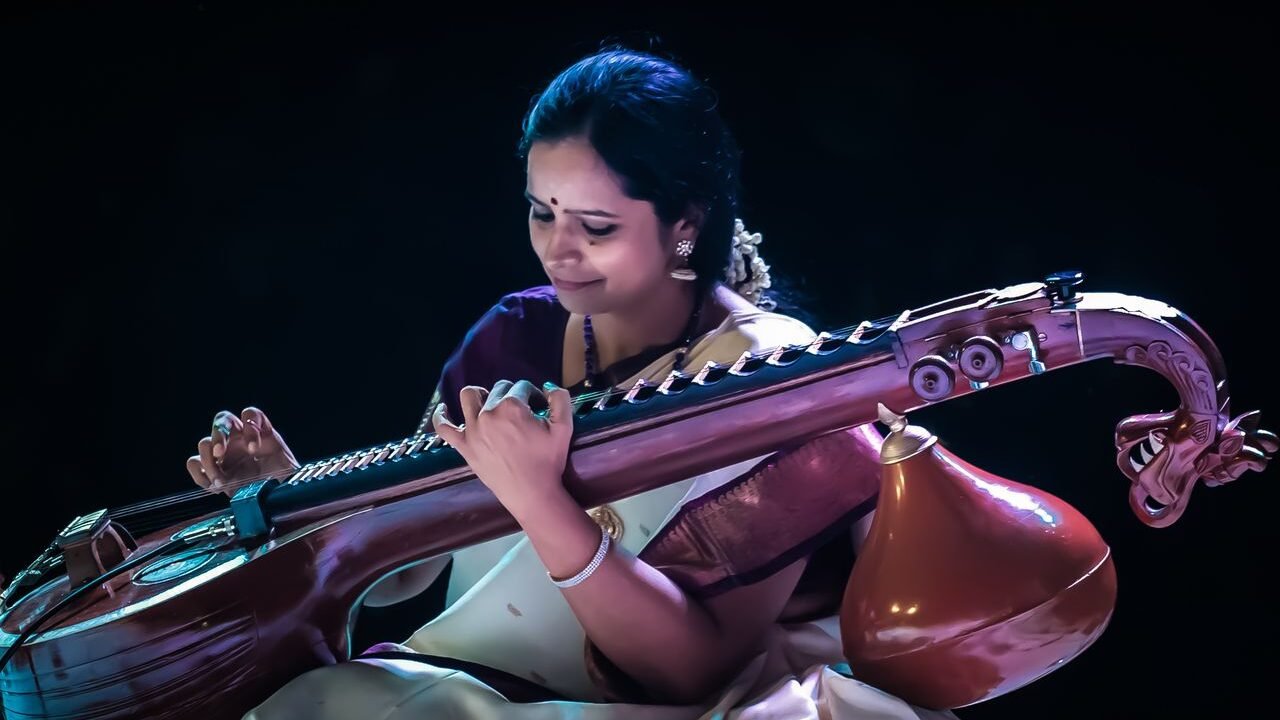
The Saraswati veena is the main plucked string instrument of Carnatic music. It has a large, hollow body carved from a single piece of wood, often jackfruit, a long neck with raised metal frets set in wax, a gourd resonator at the far end of the neck and a small decorated dragon-shaped head. It has four main playing strings, which carry the melody, and three side strings, which are plucked to mark the rhythm. The player sits on the floor with the instrument resting across the lap, and slides the strings to produce the gamakas, the ornaments and slides that give Carnatic music its character.
It is considered a model for the voice, and many Carnatic compositions are learned first on the veena. Veenas made in Thanjavur, in Tamil Nadu, have long been admired for craftsmanship. Players such as Jayanthi Kumaresh, shown above, have taken the instrument to concert halls across the world. For the wider picture of southern music, see our comparison of Hindustani and Carnatic music.

What is the rudra veena?
The rudra veena is the instrument of dhrupad, the oldest surviving form of Hindustani classical music. It has a long tube, usually made of bamboo or wood, with frets along its length, and two large gourd resonators at each end. Its sound is deep, slow and sonorous, and it is played to unfold a raga slowly in a meditative alap. The name links it to Rudra, a name of Shiva, and tradition associates the instrument with him. Playing it is difficult and the instrument was, for a time, in decline, but dedicated musicians have revived it.
The Dagar family of dhrupad musicians has been central to preserving it. Bahauddin Dagar, whose picture appears below, is counted among the best-known rudra veena players of recent decades.

What is the vichitra veena?
The vichitra veena is a fretless instrument of the Hindustani tradition, with a broad, flat neck and two large gourds. The player slides a smooth glass or wooden ball along the strings with the left hand while plucking with the right, which gives long, voice-like glides between notes. The instrument is rare today. Its southern counterpart is the gottuvadhyam, which is also played with a slide. The example below is displayed at the Raja Dinkar Kelkar Museum in Pune.

What is the Mohan veena?
The Mohan veena is the newest member of the family. It was created by the musician Vishwa Mohan Bhatt, who adapted a Hawaiian-style slide guitar with extra strings to play Indian ragas. He won a Grammy Award in 1994 for an album recorded with the American guitarist Ry Cooder. The Mohan veena is played seated, with a slide in the left hand, and it shares the singing quality of the older instruments. It shows that the idea of a “veena” keeps changing as musicians experiment.

What does the veena sound like, and what are gamakas?
The veena has a warm, sustained sound with a slight shimmer, and a long decay after each note. Players pull the string sideways across the fret to bend a note, which is how gamakas are produced. A gamaka is an ornament that shapes a note by sliding to it, oscillating around it or touching a neighbouring note. In Carnatic music the gamaka is part of the identity of a raga, not decoration, so the same notes can sound like different ragas depending on how they are ornamented. This is why the veena is used to teach ragas: it shows the shape of each phrase more clearly than a drum or a flute can.
How does the veena relate to the sitar?
Many historians see the veena as an ancestor or cousin of the sitar and sarod, which are covered in our guide to the differences between the sitar, sarod and santoor. The details of how the instruments developed are debated, so it is safer to say they belong to one broad family of Indian plucked strings than to claim a single line of descent. What is clear is that the veena set the standard for how melodic Indian instruments are built, played and taught. Some of the greatest musicians described in our article on famous Indian classical musicians grew up listening to dhrupad and the veena.
Where can you see the veena in art and temples?
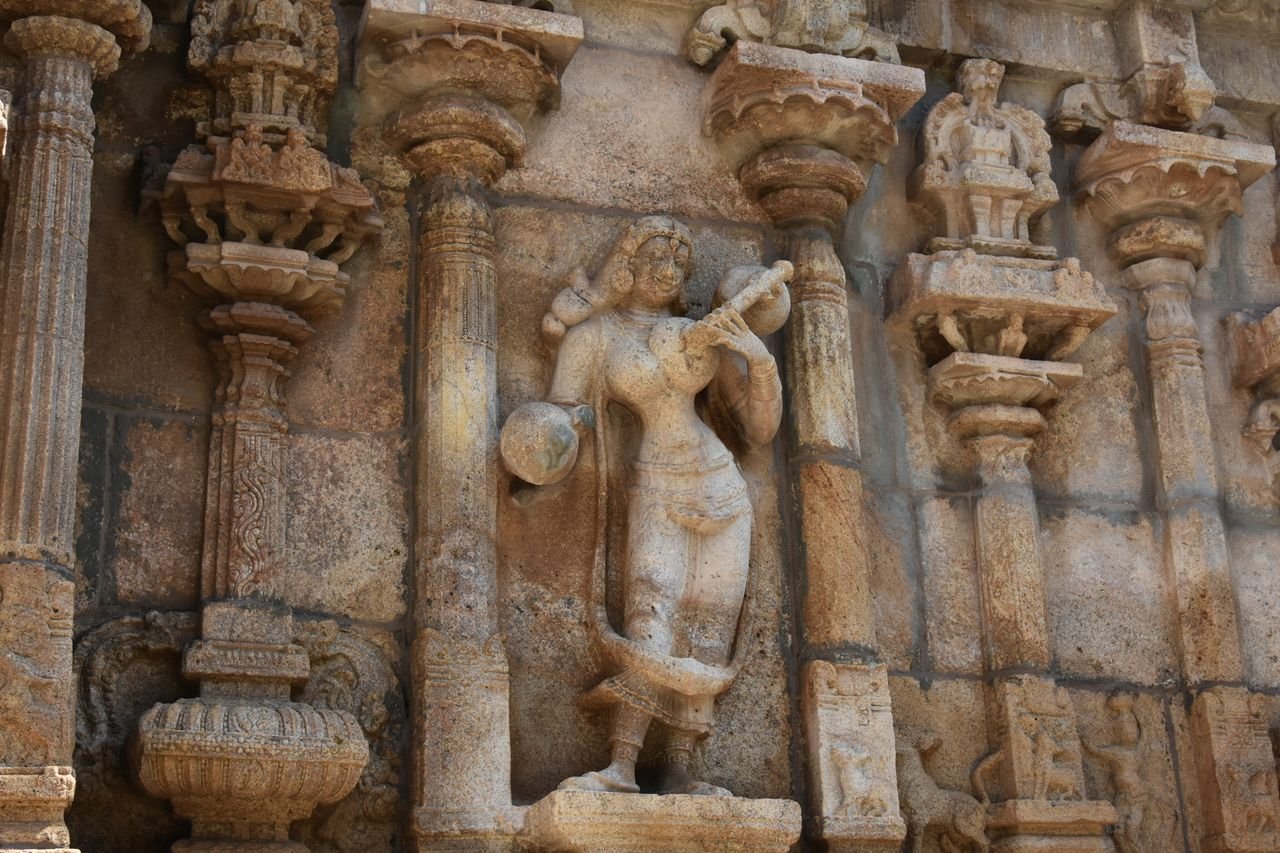
Veena players appear in temple sculpture across India. They are carved as musicians on the walls of ancient and medieval shrines, from the dancers and musicians of the Konark Sun Temple to the sculpted pillars of Hampi, and in the rich carvings of Khajuraho. In paintings, the instrument is the usual sign of Saraswati, and of the sage Narada, who is often shown with a stringed instrument. These images were a visual record of music long before sound could be recorded.
Watch: the veena in performance
These three videos show different sides of the instrument. The first features Jayanthi Kumaresh on the Saraswati veena, the second is a recording of Bahauddin Dagar playing the rudra veena, and the third shows how a Tanjavur veena is made. They are third-party videos, and their views are those of their makers.
How is the veena made, and what does it cost?
A traditional Saraswati veena takes weeks to make. Craftsmen carve the body and neck from seasoned wood, fit the frets and bridge, and finish the instrument with lacquer, inlay and the carved dragon head. The skill is partly in the tuning of the wood, since small changes affect the tone. Prices vary widely, from modest student instruments to expensive concert veenas, so ask a teacher to help you choose and check the instrument for cracks, even fret placement and good tuning pegs before you buy. A rudra veena is much rarer and is often made to order.
How can a beginner start with the veena?
Most students begin with the Saraswati veena if they are drawn to Carnatic music, learning simple exercises (sarali varisai) and then devotional songs. Start with a teacher who can correct your posture and fingering, and practise a little every day. If you are drawn to the north, a teacher may start you on the sitar or the bansuri instead, since the rudra veena is rare; our bansuri guide describes another melodic instrument. To follow the rhythm that accompanies all of them, read about taal and Teentaal, and for the moods behind the music, see Navarasa. Another way to meet Indian art is through the visual tradition in our guide to Indian folk paintings.
Sources used for this article: general reference works and the Wikipedia articles on the veena, the Saraswati veena, the rudra veena, the vichitra veena and the Mohan veena. Fret counts, construction details and the history of the instruments vary between sources, and the text says so where it matters. Photographs are used under Creative Commons licences, with credit shown beneath each picture.
Frequently asked questions
-
What is a veena?
The veena is a family of Indian plucked string instruments, including the Saraswati veena, rudra veena, vichitra veena and Mohan veena.
-
Which veena does the goddess Saraswati hold?
She is usually shown with a veena of the long-necked type. The Saraswati veena of Carnatic music is named after her.
-
What is the rudra veena?
The rudra veena is the deep-toned instrument of dhrupad, with a long tube and two large gourd resonators, associated with Shiva.
-
What is the difference between the veena and the sitar?
The veena is an older family of instruments, while the sitar is a Hindustani instrument with many sympathetic strings. Both are plucked, but they differ in build and playing style.
-
Who invented the Mohan veena?
Vishwa Mohan Bhatt created it by adapting a slide guitar to play Indian ragas, and won a Grammy Award in 1994.
-
How many strings does the Saraswati veena have?
It has four main playing strings and three side strings that mark the rhythm.
-
Which wood is used to make the Saraswati veena?
Jackfruit wood is commonly used, and Thanjavur is a long-established centre of veena making.