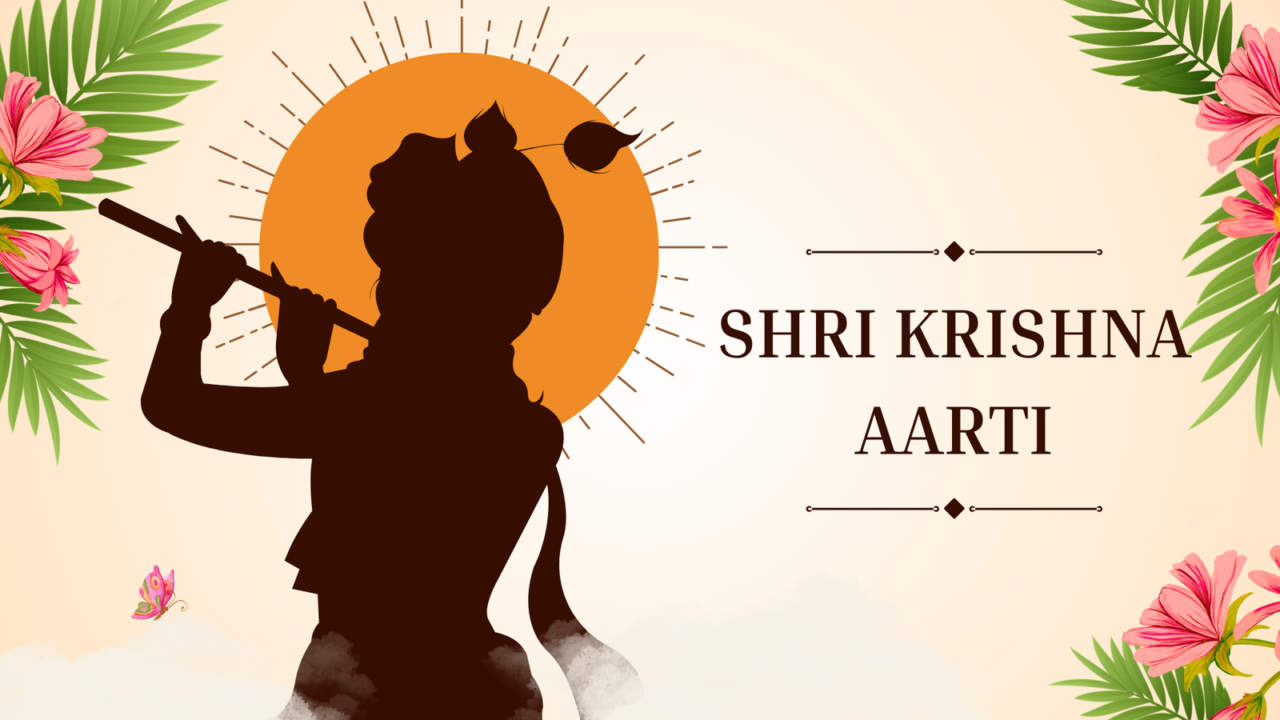
This page gives the full lyrics of Shri Krishna Bhagwan ki Aarti, known by its opening line Aarti Kunj Bihari Ki, and explains when and how devotees sing it, especially on Krishna Janmashtami, along with the offerings and meaning behind the practice.
Shri Krishna Bhagwan ki Aarti in English
Krishna Janmashtami, the festival of Lord Krishna’s birth on the Ashtami (eighth day) of the dark fortnight of Bhadrapada, is the most important occasion for this aarti. On Janmashtami, devotees try to please Laddu Gopal in many ways.
Some keep a Nirjala fast, while others chant Krishna’s name on a mala. Many offer chappan bhog, a feast of fifty-six food items. The simplest devotion of all is to sing Shri Krishna Aarti after worship.
Makhan-mishri and panchamrit are traditionally offered, and Aarti Kunj Bihari Ki is sung — devotees believe this pleases Lord Krishna. Because Krishna is believed to have been born at midnight, the principal Janmashtami aarti is performed at that hour.
Devotees perform Shri Krishna Bhagwan ki Aarti seeking the Lord’s grace and peace in the home. To go deeper, see our collection of Shri Krishna shlokas and mantras.
Shri Krishna Bhagwan ki Aarti
Aarti Kunj Bihari Ki, Shri Giridhar Krishna Murari Ki
Aarti Kunj Bihari Ki, Shri Giridhar Krishna Murari Ki
Gale Mein Vaijanti Mala, Bajave Murali Madhur Bala
Shravan Mein Kundal Jhalakla, Nand Ke Anand Nandlala
Gagan Sam Ang Kanti Kaali, Radhika Chamak Rahi Aali
Latan Mein Thade Banmaali, Bhramar Si Alak, Kasturi Tilak
Chandr Si Jhalak, Lalit Chhavi Shyama Pyari Ki
Shri Giridhar Krishna Murari Ki, Aarti Kunj Bihari Ki…
Kanakamay Mor Mukut Bilasai, Devta Darshan Ko Tarasai
Gagan So Suman Raasi Barasai, Baje Murchang, Madhur Mridang Gwalin Sang
Atul Rati Gop Kumari Ki, Shri Giridhar Krishna Murari Ki
Aarti Kunj Bihari Ki…
Jahan Te Prakat Bhai Ganga, Sakal Man Harini Shri Ganga
Smran Te Hot Moh Bhanga, Basi Shiv Sees
Jata Ke Beech, Harai Agh Keech, Charan Chhavi Shribanwari Ki
Shri Giridhar Krishna Murari Ki, Aarti Kunj Bihari Ki…
Chamakti Ujjwal Tat Renu, Baj Rahi Vrindavan Benu
Chahun Dis Gopi Gwal Dhenu
Hansat Mridu Mand, Chandani Chand, Katat Bhav Phand
Ter Sun Deen Dukhari Ki
Shri Giridhar Krishna Murari Ki
Aarti Kunj Bihari Ki…
Aarti Kunj Bihari Ki
Shri Giridhar Krishna Murari Ki
Aarti Kunj Bihari Ki
Shri Giridhar Krishna Murari Ki
Why Do Devotees Perform Shri Krishna Bhagwan Ki Aarti?
Devotees describe many spiritual, mental and emotional benefits from singing Shri Krishna Bhagwan ki Aarti. These come from tradition and personal experience rather than scientific study:
- Spiritual upliftment:
- Deepens devotion and the sense of connection with Lord Krishna.
- Supports spiritual growth and a sense of inner peace.
- A calmer mind:
- Many devotees find singing it calming at the start or end of the day.
- Turns attention towards positive, devotional thoughts.
- Emotional balance:
- Encourages feelings of love, compassion and humility.
- Helps devotees set aside anger, jealousy and resentment during worship.
- A sacred atmosphere:
- Creates a devotional atmosphere in the home.
- Devotees believe it invites divine blessings into the household.
- Strengthening faith:
- Reinforces faith and trust in the divine.
- Encourages surrender to God’s will, fostering contentment and acceptance.
- Wellbeing:
- Singing or listening to the aarti can be soothing and uplifting.
- Many find a daily devotional routine brings steadiness to their day.
- Cultural and traditional connection:
- Helps preserve and pass down religious traditions.
- Offers a way to engage with and understand Hindu heritage.
- Devotional discipline:
- Encourages a regular devotional practice.
- Builds a sense of community when sung with family or in groups.
- Moral and ethical guidance:
- Keeps Lord Krishna’s teachings in mind as a guide to a righteous life.
- Inspires a life of virtue and integrity.
By regularly performing Krishna Bhagwan ki Aarti, devotees often find themselves more centred, peaceful and aligned with their spiritual goals.

Watch Krishna Bhagwan ki Aarti | Listen Shri Krishna Aarti
Frequently Asked Questions About Krishna Bhagwan Ki Aarti
-
What is Krishna Bhagwan ki Aarti?
Krishna Bhagwan ki Aarti, popularly known by its opening line Aarti Kunj Bihari Ki, is a Hindi devotional hymn sung while waving a lit lamp before an image of Lord Krishna. It praises Krishna as Kunj Bihari, the one who roams the groves of Vrindavan, and as Giridhar, the lifter of Govardhan Hill.
-
What does Kunj Bihari mean?
Kunj Bihari means the one who wanders in the groves (kunj), a name for Lord Krishna recalling his youth among the forest bowers of Vrindavan with Radha and the gopis. The same aarti also calls him Giridhar, the lifter of Govardhan Hill, and Murari, the enemy of the demon Mura.
-
When is Krishna Bhagwan ki Aarti sung?
Aarti Kunj Bihari Ki is sung daily in Krishna temples and homes, and above all on Krishna Janmashtami, the festival of Krishna’s birth on the Ashtami of the dark fortnight of Bhadrapada. On Janmashtami devotees traditionally perform it at midnight, the hour of his birth.
-
What are the benefits of singing Krishna Bhagwan ki Aarti?
Devotees traditionally sing Krishna Bhagwan ki Aarti to deepen devotion, find calm and invite Lord Krishna’s blessings for peace in the home, and singing together draws families into shared worship. These are devotional benefits described by tradition and personal experience, not medical or scientific claims.
-
How is Krishna Bhagwan ki Aarti performed?
Krishna Bhagwan ki Aarti is performed by waving a lit ghee or camphor lamp in clockwise circles before an image or idol of Lord Krishna while singing the hymn, usually with ringing bells and often a conch. Devotees then pass their hands over the flame and touch their eyes to receive its blessing.
-
What is offered to Lord Krishna during the aarti?
Traditional offerings to Lord Krishna during the aarti include makhan-mishri (butter with rock sugar), panchamrit, tulsi leaves, flowers, fruits and incense. Butter is especially associated with Krishna, recalling his childhood as Makhan Chor, the butter thief of Gokul, and on Janmashtami some devotees offer chappan bhog, 56 food items.
-
Can Krishna Bhagwan ki Aarti be performed at home?
Yes. Krishna Bhagwan ki Aarti can be performed at home as part of daily worship, in front of a picture or idol of Krishna or Laddu Gopal. It needs only a lamp, some flowers or tulsi leaves and a simple offering, and many families sing it each morning and evening.
-
What is the best time to sing Krishna Bhagwan ki Aarti?
Krishna Bhagwan ki Aarti is traditionally sung in the morning after puja and in the evening at dusk, the two most common times in household worship. On Krishna Janmashtami the principal aarti is performed at midnight, marking the moment of Krishna’s birth in Mathura.
-
What aartis are performed daily in Krishna temples?
Many Krishna temples, particularly in Vaishnava and Pushtimarg traditions, hold several aartis a day, including Mangla Aarti before dawn, Shringar after the deity is dressed, Rajbhog at midday, Sandhya at dusk and Shayan before the deity rests at night. Timings vary between temples.
-
Can anyone sing Krishna Bhagwan ki Aarti?
Yes. Anyone can sing Krishna Bhagwan ki Aarti, regardless of background, age or caste, and no initiation is required. What tradition emphasises is sincere devotion rather than ritual perfection, so it is equally suited to temple worship, family prayer and individual practice.