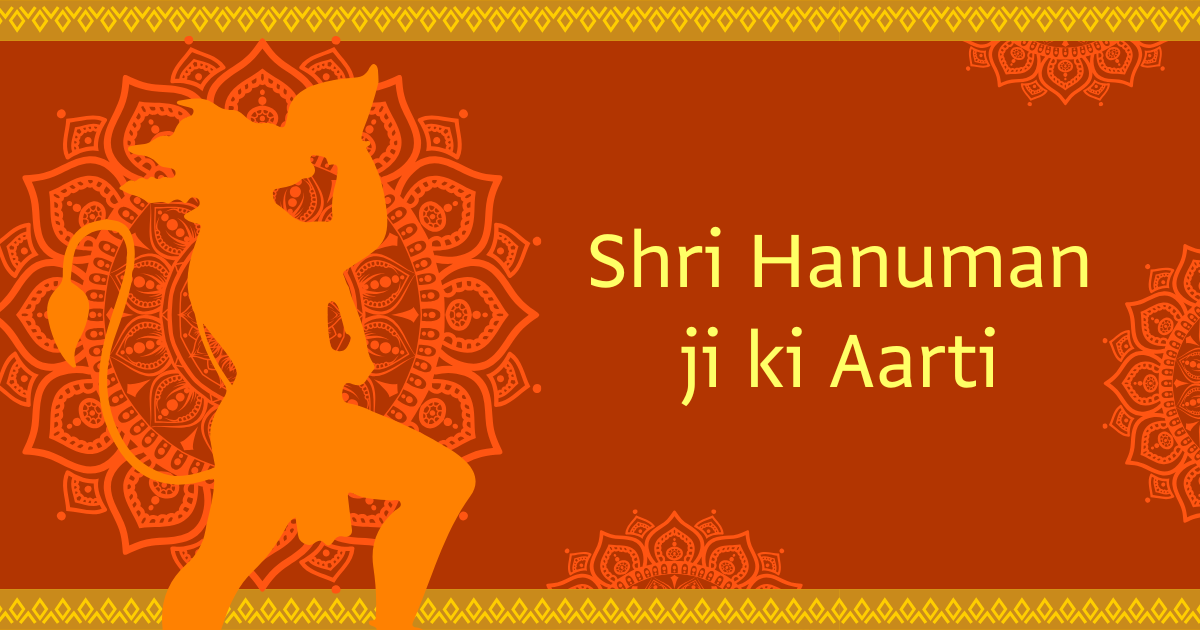
This page gives the complete lyrics of Hanuman Ji Ki Aarti, known by its opening line Aarti Kije Hanuman Lala Ki, with the meaning of every line, and explains when and how devotees sing it.
Who Is Hanuman Ji?
Hanuman Ji is the supreme devotee of Shri Ram and a symbol of strength, courage and devotion. The son of Anjana and Kesari, born with the blessing of Vayu, the wind god, he plays a central role in the Ramayana — finding Sita in Lanka, burning the city and bringing the Sanjeevani herb. Read more about who Hanuman is.
What Is the Hanuman Aarti and Why Is It Important?
Hanuman Aarti is a devotional hymn sung while waving a lamp before Lord Hanuman, praising his qualities, strength and deeds. Its verses retell his Ramayana exploits — the crossing to Lanka, the Sanjeevani herb, the defeat of Ahiravan — so that singing it is also a way of remembering his story.
Devotees describe many benefits from regular aarti, from peace of mind to greater confidence in difficult situations. Performed together, it also brings families into shared worship. These are devotional experiences drawn from faith rather than scientific claims.
Why Do Devotees Perform Hanuman Ji Ki Aarti?
- Peace of mind: Many devotees find that regular aarti brings calm and steadiness.
- Confidence: Singing of Hanuman’s courage inspires devotees to face challenges without fear.
- Protection: Devotees believe Hanuman guards them against negative forces, as the aarti itself describes.
- Spiritual growth: The aarti deepens devotion and keeps Hanuman’s example of service in mind.
- Strength in difficulty: Devotees seek Hanuman’s help, as Sankat Mochan, in resolving life’s troubles.
- Removal of obstacles: Devotees pray for obstacles in their path to be cleared.
- Family harmony: Singing together brings the household into shared devotion.
- Purity of thought: The practice turns the mind towards good thoughts and actions.
- Strengthening faith: Regular aarti deepens the devotee’s connection with Lord Hanuman.
Hanuman Ji Ki Aarti in English | Lord Hanuman Aarti in English
Aarti Kije Hanuman Lala Ki, Dusht dalan Raghunath kala ki.
Jake bal se girivar kanpe, Rog dosh jake nikat na jhanke.
Anjani putra maha baldaayi, Santan ke prabhu sada sahayi.
De bira Raghunath pathaye, Lanka jari Sita sudhi laye.
Lanka so kot samudra-si khayi, Jat pavansut bar na layi.
Lanka jari asur sanhare, Siyaramji ke kaj savare.
Lakshman moorachit pade sakare, Aani sanjivan praan ubare.
Paithi patal tori jam-kare, Ahiravan ki bhuja ukhare.
Bayein bhuja asur dal mare, Dahine bhuja santjan tare.
Sur-nar-muni jan aarti utare, Jai jai jai Hanuman uchare.
Kanchan thaar kapoor lau chhayi, Aarti karat Anjani maiya.
Jo Hanuman ji ki aarti gavai, Basi Baikunth param pad pavai.
Shri Hanuman Aarti ke bol samapan
Meaning of Hanuman Ji Ki Aarti in English
Aarti Kije Hanuman Lala Ki, Dusht dalan Raghunath kala ki.
Perform the aarti (worship with light) of beloved Hanuman, the destroyer of the wicked and a manifestation of Lord Rama’s divine power.
Jake bal se girivar kanpe, Rog dosh jake nikat na jhanke.
By whose strength the mountains tremble, and near whom no disease or fault dares approach.
Anjani putra maha baldaayi, Santan ke prabhu sada sahayi.
He is the son of Anjani, immensely powerful, and always helps the devotees and saints.
De bira Raghunath pathaye, Lanka jari Sita sudhi laye.
The brave one, sent by Lord Rama, who burned Lanka and brought back news of Sita.
Lanka so kot samudra-si khayi, Jat pavansut bar na layi.
Lanka, a fortress ringed by the sea as its moat, was no obstacle for the son of the wind god, who crossed it without delay.
Lanka jari asur sanhare, Siyaramji ke kaj savare.
Burning Lanka and killing the demons, he accomplished the work of Sita and Rama.
Lakshman moorachit pade sakare, Aani sanjivan praan ubare.
When Lakshman lay unconscious on the battlefield, Hanuman brought the Sanjeevani herb and saved his life.
Paithi patal tori jam-kare, Ahiravan ki bhuja ukhare.
He entered the netherworld (Patala), broke through its fearsome hold, and tore off the arms of the demon Ahiravan.
Bayein bhuja asur dal mare, Dahine bhuja santjan tare.
With his left arm he struck down the demon armies, and with his right arm he rescued the saints.
Sur-nar-muni jan aarti utare, Jai jai jai Hanuman uchare.
Gods, humans and sages perform his aarti, and chant “Victory, victory, victory to Hanuman.”
Kanchan thaar kapoor lau chhayi, Aarti karat Anjani maiya.
On a golden plate the camphor flame spreads its light, as mother Anjani performs the aarti.
Jo Hanuman ji ki aarti gavai, Basi Baikunth param pad pavai.
Whoever sings this aarti of Hanuman will dwell in Vaikuntha, the supreme abode, and attain the highest state.
Devotees usually sing this aarti after reciting the Hanuman Chalisa with meaning. For more prayers, see our Hanuman shlokas with meanings.
Watch Shri Hanuman Ji Ki Aarti | Listen to Shri Hanuman Ji Ki Aarti
Frequently Asked Questions About Hanuman Ji Ki Aarti
-
What is Hanuman Ji Ki Aarti?
Hanuman Ji Ki Aarti, known by its opening line Aarti Kije Hanuman Lala Ki, is a Hindi devotional hymn sung while waving a lamp before an image of Lord Hanuman. Its verses recount his deeds from the Ramayana, including burning Lanka, bringing the Sanjeevani herb and defeating the demon Ahiravan.
-
When is Hanuman Ji Ki Aarti sung?
Hanuman Ji Ki Aarti is traditionally sung on Tuesdays and Saturdays, the days considered most auspicious for Hanuman worship, and on Hanuman Jayanti. In daily worship it is usually sung in the morning and evening, often immediately after reciting the Hanuman Chalisa.
-
What does Hanuman Lala mean?
Hanuman Lala means Hanuman the beloved child, since lala is an affectionate Hindi word for a young son. The opening line, Aarti kije Hanuman Lala ki, dusht dalan Raghunath kala ki, invites devotees to worship beloved Hanuman, destroyer of the wicked and a manifestation of Lord Rama’s power.
-
Who is Ahiravan in the Hanuman Aarti?
Ahiravan was a demon king of Patala, the netherworld, who in later Ramayana traditions abducted Rama and Lakshmana. Hanuman descended into Patala, took his five-faced Panchmukhi form to defeat him and rescued them, an episode the aarti recalls in the line Ahiravan ki bhuja ukhare.
-
How is Hanuman Ji Ki Aarti performed?
Hanuman Ji Ki Aarti is performed by waving a lamp of ghee or camphor in clockwise circles before an image of Hanuman while singing, usually with a bell. Devotees traditionally offer red flowers, sindoor, and jaggery with gram (gur-chana), and on Saturdays some light a mustard-oil lamp.
-
What does the last line of the Hanuman Aarti mean?
The closing line, Jo Hanuman ji ki aarti gavai, basi Baikunth param pad pavai, states the traditional belief that whoever sings Hanuman’s aarti will dwell in Vaikuntha, the abode of Vishnu, and attain the highest spiritual state. Such a closing verse, called a phalashruti, is common in Hindu hymns.
-
What are the benefits of singing Hanuman Ji Ki Aarti?
Devotees traditionally sing Hanuman Ji Ki Aarti for courage, protection, peace of mind and the removal of obstacles, and many find it steadies the mind before difficult tasks. These are devotional benefits drawn from faith and personal experience, not medical claims, and the aarti is not a substitute for medical care.
-
Can Hanuman Ji Ki Aarti be performed at home?
Yes. Hanuman Ji Ki Aarti can be performed at home, alone or with family, before a picture or idol of Hanuman. It needs only a lamp, a few flowers and a simple offering such as jaggery and gram, and a single aarti with its preparations takes around 10 to 15 minutes.
-
What is the difference between the Hanuman Aarti and the Hanuman Chalisa?
The Hanuman Aarti and the Hanuman Chalisa are separate prayers. The Chalisa is a 40-verse hymn by Tulsidas recited as a meditation on Hanuman’s qualities, while the aarti is a shorter song sung while waving a lamp. In household worship devotees usually recite the Chalisa first and close with the aarti.
-
Why is a lamp waved during Hanuman Ji Ki Aarti?
Waving a lit lamp during aarti symbolises the removal of darkness and ignorance by divine light, and honours the deity by offering light before the image. After the aarti, devotees pass their hands over the flame and touch their eyes and head to receive the blessing it carries.